I believe Christians should stop calling civil government “the Government”

I believe Christians should stop calling civil government “the Government,” as though it were the highest, final, and comprehensive authority over human life. It is not the government. It is civil government: a limited, delegated, accountable, and temporary authority under God.
The only rule worthy of being called the Government in the ultimate sense is the rule and reign of Jesus Christ. Christ alone possesses absolute authority. After His resurrection, Jesus declared, “All authority in heaven and on earth has been given to me” (Matthew 28:18). That statement leaves no realm outside His dominion. Heaven belongs to Him. Earth belongs to Him. Kings, nations, courts, constitutions, armies, families, churches, and individual consciences all stand beneath His sovereign rule.
Civil government has real authority, but it does not have ultimate authority. Romans 13:1 says, “Let every person be subject to the governing authorities. For there is no authority except from God.” That means civil government is not self-created, self-justifying, or self-defining. It receives its authority from God. It is derivative, not original. It is delegated, not absolute. It is accountable, not sovereign.
Paul goes on to say that the civil ruler is “God’s servant for your good” and “an avenger who carries out God’s wrath on the wrongdoer” (Romans 13:4). This tells us the proper sphere of civil government. Civil government exists to preserve public order, punish evil, protect the innocent, and administer public justice. It bears the sword, not the keys of the kingdom. It may punish crime, but it cannot forgive sin. It may restrain evil, but it cannot regenerate the heart. It may enforce law, but it cannot define righteousness apart from God.
Peter teaches the same thing when he says that governors are sent “to punish those who do evil and to praise those who do good” (1 Peter 2:14). Civil government therefore has a moral task, but that task is limited. It is not the savior of mankind. It is not the source of truth. It is not the creator of rights. It is not the head of the church. It is not the lord of the conscience. It is one ordained institution among others, and it must remain within the boundaries God has assigned to it.
Christ’s government is altogether different. Isaiah prophesied of the Messiah, “The government shall be upon his shoulder” (Isaiah 9:6). His kingdom is not merely another political administration. It is the righteous reign of the Son of God. Isaiah continues, “Of the increase of his government and of peace there will be no end” (Isaiah 9:7). Civil governments rise and fall. Empires appear and vanish. Presidents leave office. Judges die. Legislatures change. But Christ’s government increases and never ends.
Psalm 2 shows the nations raging and the rulers of the earth plotting against the Lord and His Anointed. Yet God does not tremble before human rebellion. He laughs and declares, “As for me, I have set my King on Zion, my holy hill” (Psalm 2:6). The kings of the earth are then commanded to “serve the LORD with fear” and “kiss the Son” (Psalm 2:11–12). This means civil rulers are not religiously neutral before Christ. They are morally accountable to Him. They may refuse to acknowledge Him, but they cannot escape His authority.
Colossians 1:16 says that “by him all things were created, in heaven and on earth, visible and invisible, whether thrones or dominions or rulers or authorities.” Thrones, rulers, and authorities do not exist outside of Christ. They were created through Him and for Him. Civil government does not belong to itself. It belongs to Christ. Every magistrate is ruling in a world made by Christ, sustained by Christ, and destined to be judged by Christ.
Ephesians 1:20–22 says that God raised Christ from the dead and seated Him at His right hand “far above all rule and authority and power and dominion,” and that He “put all things under his feet.” This is the difference between civil government and Christ’s reign. Civil government is under Christ’s feet. Christ is never under civil government’s feet. Civil authority may command obedience within its rightful sphere, but it is never the final court of appeal. Christ is.
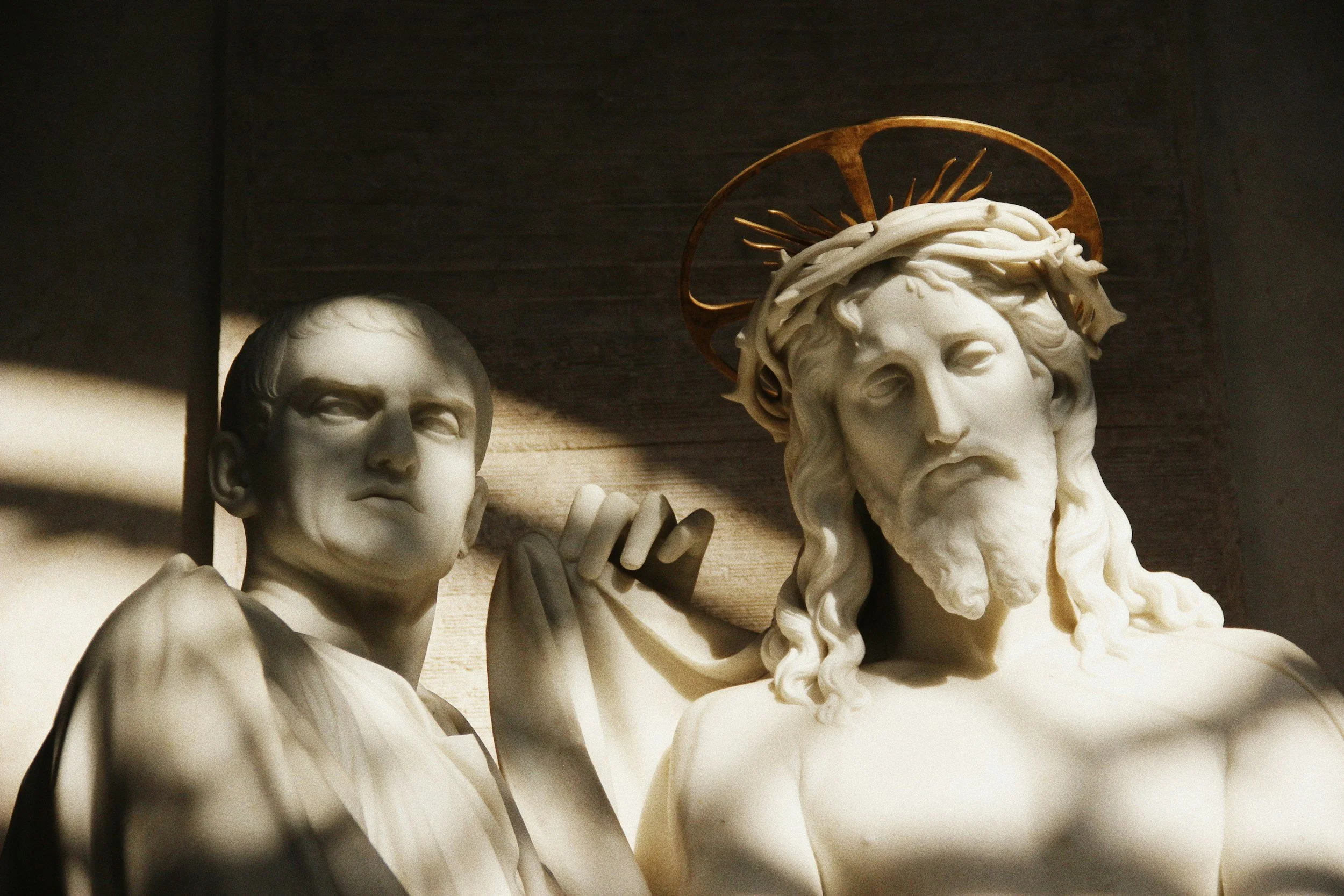
This distinction becomes especially clear when Jesus stands before Pilate. Pilate says, “Do you not know that I have authority to release you and authority to crucify you?” Jesus answers, “You would have no authority over me at all unless it had been given you from above” (John 19:10–11). Pilate had real civil authority, but it was given authority. It was limited authority. It was accountable authority. Even the Roman governor who sentenced Christ to death was not sovereign over Christ. He was acting under a providence he did not understand, and before a King he did not recognize.
Jesus also said, “My kingdom is not of this world” (John 18:36). He did not mean His kingdom has nothing to say to this world. He meant His kingdom does not originate from this world, depend upon this world, or advance by the weapons of this world. Christ’s reign is heavenly in origin, spiritual in power, righteous in character, and universal in scope. Civil Government may rule by law, courts, taxation, and the sword. Christ rules by truth, Spirit, Word, providence, judgment, grace, and resurrection power.
Martin Luther made this distinction powerfully in Temporal Authority: To What Extent It Should Be Obeyed. He wrote, “No one can become righteous in the sight of God by means of the temporal government.” Luther’s point was not that civil Government is evil or unnecessary, but that it is limited. It can restrain outward wickedness, preserve public peace, and punish evildoers, but it cannot make sinners righteous before God. That belongs to Christ’s Government alone. Civil Government may command the body, regulate public conduct, and bear the sword against crime; Christ governs the heart, forgives sin, grants righteousness, and brings men into the kingdom of God. This is why Christians must distinguish between the magistrate’s authority and the Messiah’s reign. The magistrate can restrain evil, but Christ redeems sinners. The state can punish lawbreakers, but Christ justifies the ungodly. Civil Government may keep order in the street, but only Christ can establish peace with God.
This is why Christians must give civil Government its due without giving it what belongs to God. Jesus said, “Render to Caesar the things that are Caesar’s, and to God the things that are God’s” (Mark 12:17). Caesar may receive taxes, honor, and lawful obedience. But Caesar does not receive worship. Caesar does not own the image of God. Caesar does not possess the conscience. Caesar does not define the church’s mission. Caesar is not Lord. Christ is Lord.
When civil Government commands what God forbids, or forbids what God commands, Christians must answer as the apostles did: “We must obey God rather than men” (Acts 5:29). This is not anarchy. It is ordered obedience. Christians are not free to despise civil Government, but neither are they free to absolutize it. We honor the emperor, but we fear God (1 Peter 2:17). That order matters. The fear of God is supreme. Honor to rulers is real, but secondary.
Calling it civil Government reminds us that God has established more than one sphere of human authority. There is self-government, because every man is responsible before God for his own conduct. There is family government, because husbands, wives, parents, and children have God-given duties in the household. There is church government, because Christ has given elders to shepherd His people and the keys of the kingdom to His church. And there is civil Government, because God has ordained magistrates to preserve justice and public order. None of these spheres is absolute. All of them are under Christ.
Therefore, our language should reflect our theology. When Christians casually call civil government “the Government,” we may unintentionally train our minds to think of the state as the supreme ruler of society. But Scripture teaches something better. Civil Government is real, but limited. Necessary, but not ultimate. Ordained, but accountable. Powerful, but temporary. It is a servant of God, not a substitute for God.
The only Government worthy of ultimate allegiance is the Government resting on Christ’s shoulders. He is “the ruler of kings on earth” (Revelation 1:5). He is “King of kings and Lord of lords” (Revelation 19:16). He is the One before whom every knee will bow and every tongue confess that He is Lord (Philippians 2:10–11).
So let Christians speak clearly. It is not the Government. It is civil Government under Christ. It is not supreme. Christ is supreme. It is not sovereign. Christ is sovereign. It is not Lord. Christ is Lord.
We honor civil Government when it remains within its God-given bounds. We resist it when it rebels against God. We pray for rulers, pay what is owed, obey lawful commands, seek justice, and live as good citizens. But above all, we confess that Jesus Christ reigns over every nation, every ruler, every law, every court, every election, every empire, and every human heart.
There is civil Government. But there is only one King over all.
Christ over all.