Monday men: Carl F Henry, who was he and what did he do?
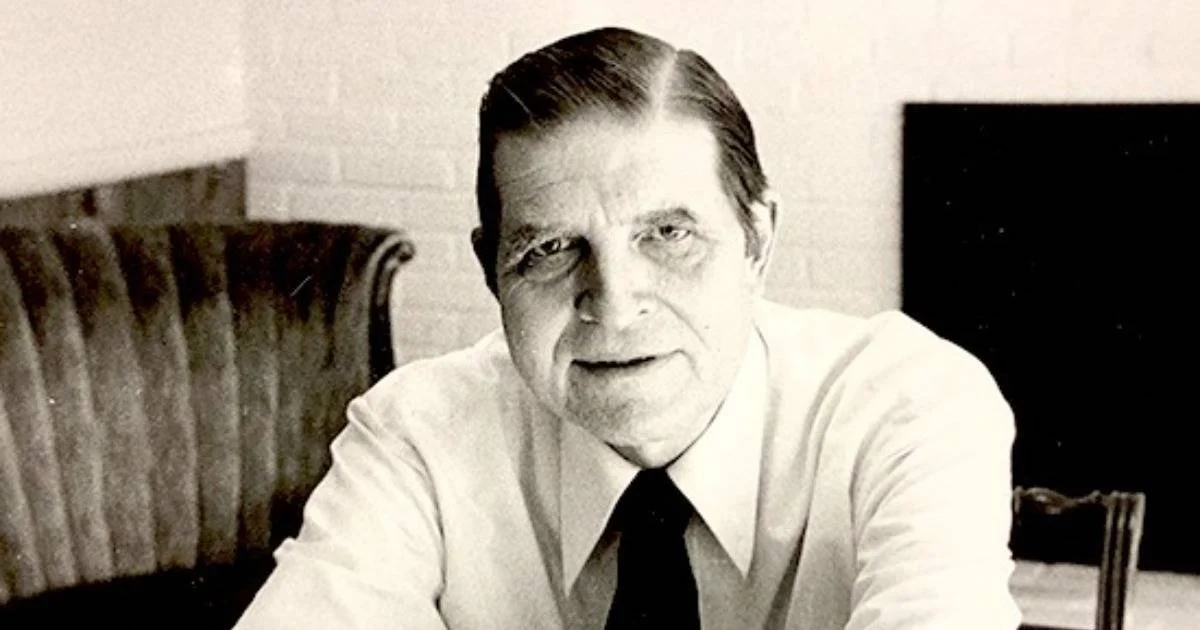
Carl Ferdinand Howard Henry was one of the most important evangelical theologians of the twentieth century. He was a theologian, journalist, editor, professor, author, and public intellectual who helped define the identity of modern American evangelicalism after World War II. While men like Billy Graham gave evangelicalism a public evangelistic voice, Henry gave it theological and intellectual substance. He believed that Christianity was not merely a private experience or a set of personal devotional beliefs, but the revealed truth of God that speaks to every area of life. His work called evangelicals to be biblically faithful, intellectually serious, culturally engaged, and publicly courageous.
Henry was born on January 22, 1913, in New York City to German immigrant parents. He was raised on Long Island and did not grow up in a strongly religious home. His early life was shaped more by journalism than theology. As a young man, he entered newspaper work and became skilled in writing, editing, and public communication. By the age of nineteen, he was editing a weekly newspaper in Suffolk County, New York. This early experience in journalism would later prove significant. Henry learned how ideas moved through public discourse, how words could shape institutions, and how Christianity needed a thoughtful voice in the public square. Before he became known as a theologian, he was already learning to think and write as a communicator.
Henry’s conversion came through the witness of a Christian woman named Mildred Christy, who worked with him in the newspaper office. The story often told is that Henry used the Lord’s name carelessly, and she gently but firmly rebuked him by saying that she would rather he slap her face than take the name of her best Friend in vain. Her words struck him deeply. Through her witness and the work of God in his heart, Henry came to personal faith in Christ. This conversion redirected the course of his life. He turned from journalism as merely a profession to Christian thought as a calling. He came to see that truth mattered because God had spoken, and that the Christian faith deserved to be defended, explained, and proclaimed with intellectual seriousness.
Henry attended Wheaton College, where he earned both bachelor’s and master’s degrees. At Wheaton, he was part of a generation of young evangelicals who would later shape American Protestantism, including Billy Graham and Harold Lindsell. He also met Helga Bender, whom he married in 1940. Their marriage produced two children and endured through decades of teaching, writing, travel, and public ministry. After Wheaton, Henry continued his theological education at Northern Baptist Theological Seminary, where he earned a bachelor of divinity and doctor of theology degree. He later completed a Ph.D. at Boston University. His academic preparation was unusually broad, combining theology, philosophy, ethics, and communication.
Henry began teaching at Northern Baptist Theological Seminary in the early 1940s. During these years, he became increasingly concerned about the state of American fundamentalism. He appreciated fundamentalism’s defense of biblical truth against theological liberalism, but he believed that many fundamentalists had retreated into a narrow separatism that failed to address the moral and cultural issues of the day. In 1947, Henry published The Uneasy Conscience of Modern Fundamentalism, the book that made his name. In that work, he argued that Bible-believing Christians must not abandon the world to secularism, liberalism, or unbelief. Evangelicals must preach the gospel of personal salvation, but they must also speak to justice, ethics, public life, and the social order. This book became a manifesto for the emerging “new evangelicalism.”
That same year, Henry joined the founding faculty of Fuller Theological Seminary in Pasadena, California. Fuller was created as a new kind of evangelical institution, one that sought to combine doctrinal orthodoxy with academic seriousness and cultural engagement. Henry served as Fuller’s first professor of theology and also helped provide administrative and intellectual leadership in the seminary’s early years. His work at Fuller placed him at the center of the postwar evangelical movement. He stood alongside figures like Harold Ockenga, Charles Fuller, Billy Graham, and Harold Lindsell in seeking to build an evangelicalism that was neither liberal nor isolationist, but confessionally orthodox and publicly engaged.
In 1956, Henry became the founding editor of Christianity Today. The magazine was launched with the support of Billy Graham and others as an evangelical alternative to the more theologically liberal Christian Century. This role may have been Henry’s most publicly influential position. As editor, he sought to give evangelicalism a serious journalistic and theological voice. Christianity Today under Henry’s leadership did not simply report church news. It engaged theology, ethics, politics, culture, missions, science, and public controversy from an evangelical standpoint. Henry wanted the magazine to show that biblical Christianity was intellectually credible, historically rooted, and publicly relevant.
Henry served as editor until 1968. Those years were crucial for the development of modern evangelical identity. Through Christianity Today, Henry helped gather scholars, pastors, writers, and leaders into a common conversation. He believed evangelicalism needed more than revival meetings and denominational institutions. It needed theological clarity, intellectual discipline, and cultural responsibility. His editorial work helped convince many that conservative Protestantism could be both doctrinally orthodox and intellectually respectable. He was not interested in making Christianity acceptable to unbelief by compromising doctrine. Rather, he wanted to show that unbelief had no right to claim the intellectual high ground.
After leaving Christianity Today, Henry continued teaching, writing, lecturing, and serving the wider evangelical world. He taught at Eastern Baptist Theological Seminary and Trinity Evangelical Divinity School, and he served in various roles connected to World Vision, Prison Fellowship, and international evangelical conferences. He was also involved in major evangelical gatherings, including the 1966 World Congress on Evangelism in Berlin and the 1974 Lausanne Congress. Henry’s influence was not limited to the classroom or the printed page. He functioned as an evangelical statesman, calling churches, seminaries, mission agencies, and public leaders to think faithfully about the gospel and the world.
Henry’s greatest theological work was God, Revelation, and Authority, a six-volume project published between 1976 and 1983. In this massive work, he defended the authority of divine revelation, the truthfulness of Scripture, and the rational coherence of Christian theism. He argued that God has spoken, that revelation is intelligible, and that Scripture gives objective truth in propositional form. Henry rejected both liberal theology, which surrendered biblical authority, and irrational forms of religion that separated faith from truth. He believed Christianity rests on God’s self-disclosure and that the Bible is the authoritative written Word of God.
Henry died on December 7, 2003, in Watertown, Wisconsin, at the age of ninety. By the time of his death, he was widely regarded as the “dean” of evangelical theologians. His legacy is seen in evangelical seminaries, publishing houses, journals, mission movements, and public theology. He taught evangelicals that faithfulness to Scripture does not require retreat from culture, and engagement with culture does not require surrendering Scripture. Carl F. H. Henry’s life reminds the church that truth must be defended, proclaimed, and applied. He gave evangelicalism a mind, a conscience, and a public voice, calling Christians to hold together biblical authority, gospel proclamation, theological depth, and cultural responsibility.